
Wolfgang Flad | Tanja Selzer – LIAISONS
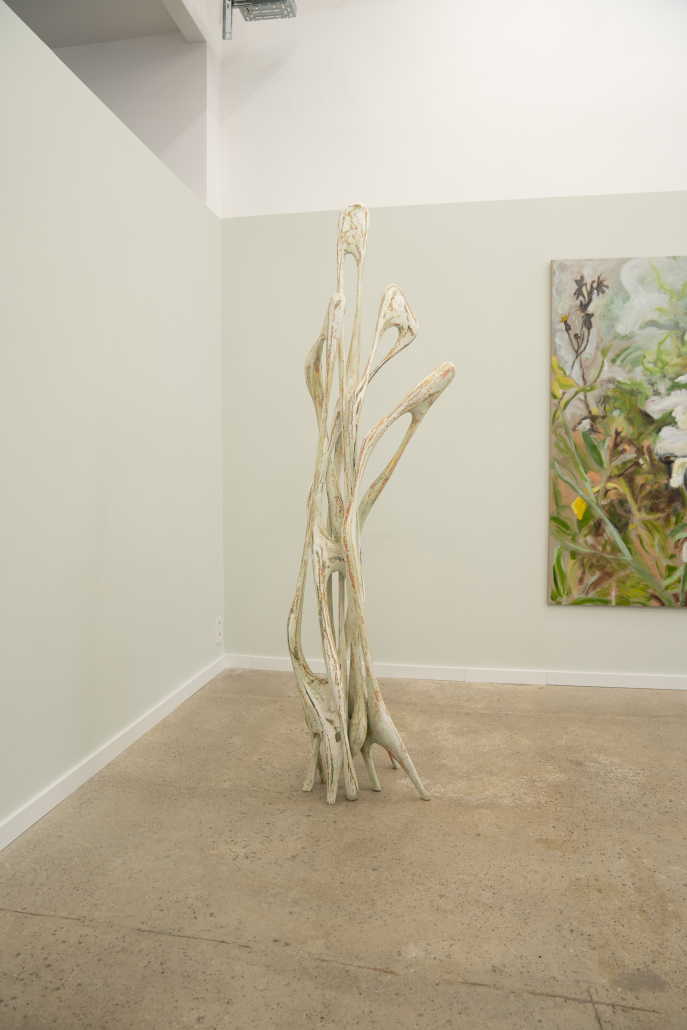
Wolfgang Flad | Tanja Selzer LIAISONS Sculpture| Painting
LIAISONS did not emerge from a theme, but from an encounter.
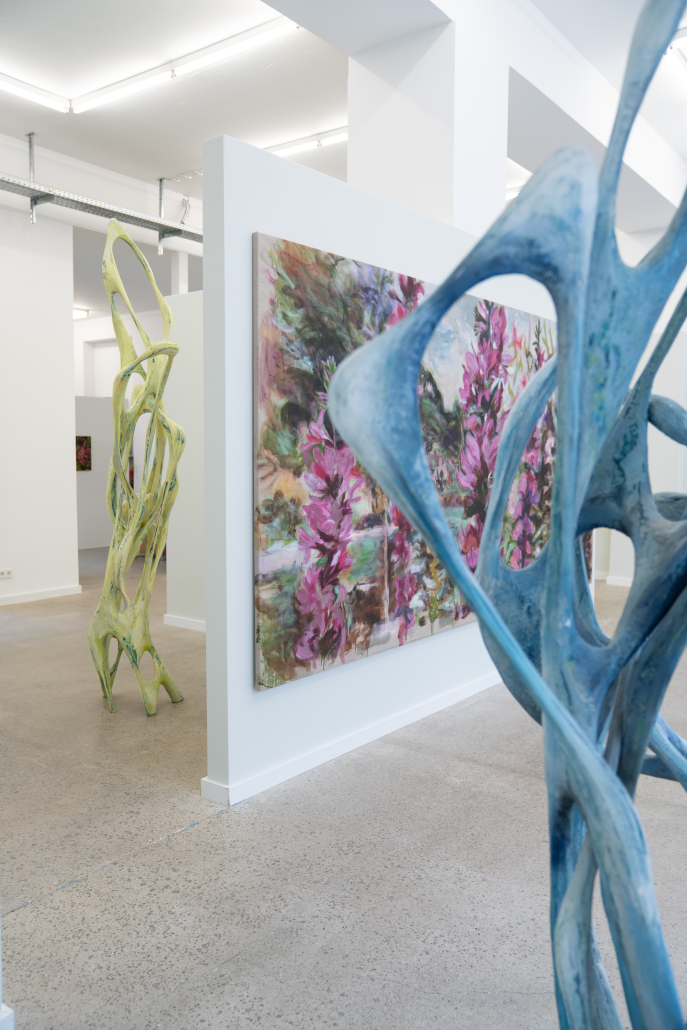
The exhibition brings together works by Tanja Selzer and Wolfgang Flad for the first time. In painting and sculpture, two independent artistic positions meet, each exploring organic structures, growth and transformation in different ways. Their dialogue creates an open network of relationships – between form and space, humankind and nature, perception and memory.
Over many years, both artists have developed distinctive artistic languages and work in different media. At the same time, an underlying affinity can be discerned between their works, rooted less in formal similarities than in shared questions and attitudes: an interest in organic structures, open-ended processes of form and the manifold relationships between people, nature and the environment.
Programme:
Thursday, 10 September 2026, 6 p.m.
Vernissage. The artists will be present.
DJ Balthazar is playing.
Thursday, 01 October 2026, 6 p.m.
Guided Talk with the artists
Saturday, 24 October 2026, 4 – 6 p.m.
Closing event
The title “LIAISONS” refers not only to the encounter between two artistic positions, but to a multitude of connections: between painting and sculpture, surface and body, colour and material, growth and structure, the visible and the imagined. Rather than reducing these relationships to a single statement, the exhibition allows them to emerge alongside one another, to touch, diverge and form new connections.
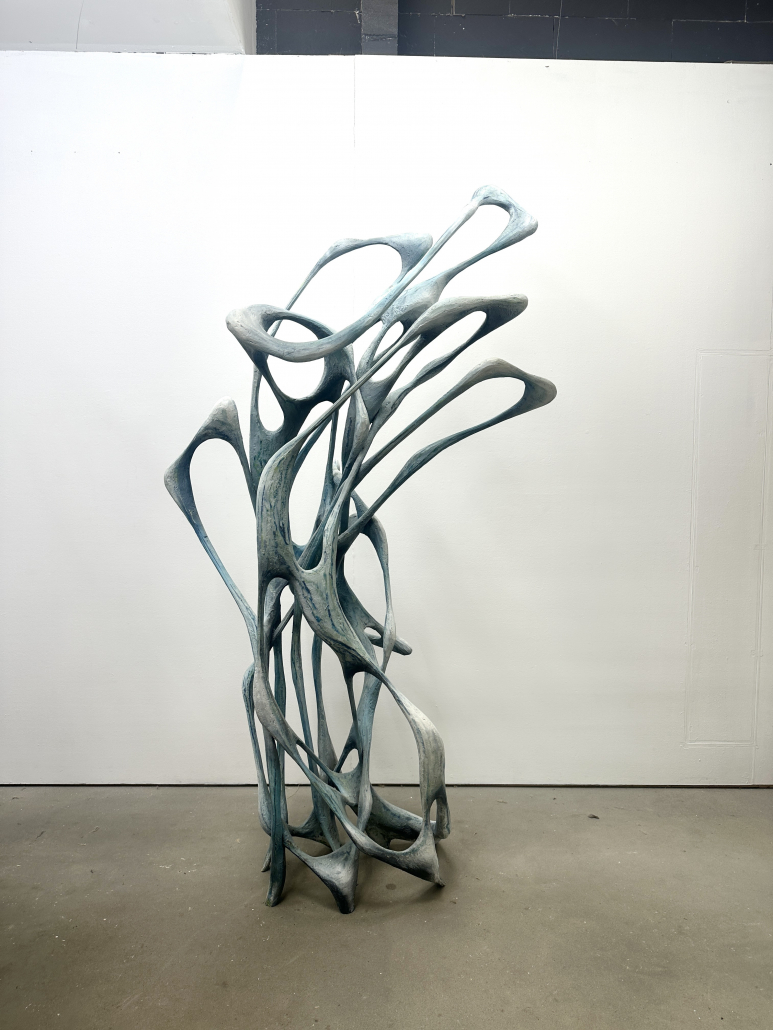
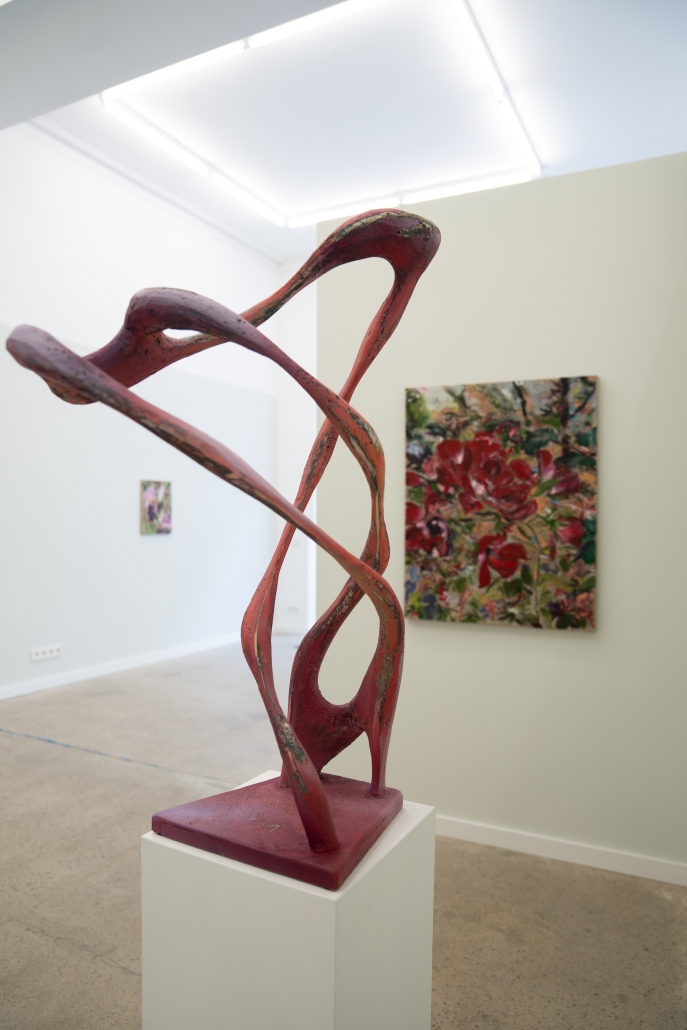
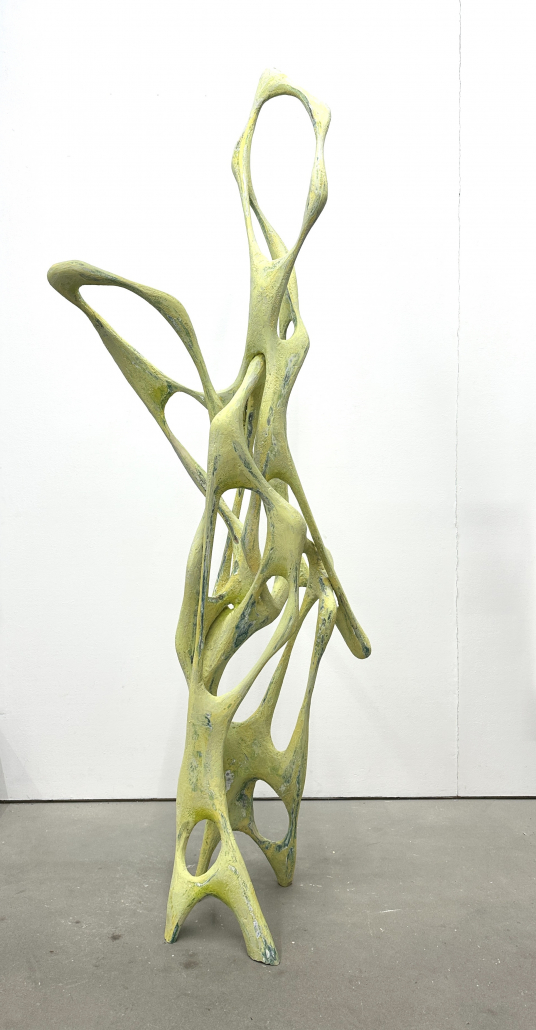
Wolfgang Flad’s sculptures appear as organic structures that expand into space and change their form with shifting viewpoints, light and movement. They evoke plants, corals, roots, bones or cellular structures without depicting any of them directly. Flad does not create representations of nature. Instead, his works follow principles that also underlie natural processes of growth: branching, repetition, expansion, condensation and the fragile balance between stability and movement.
The open structures of his sculptures do not simply occupy the space around them. They articulate it, enclose empty spaces and at the same time open it up to new lines of sight. Mass and void become equally important elements of the work. The gaze can wander through the forms; the sculpture changes with every step taken by the viewer. Rather than appearing as a self-contained object, it becomes a spatial structure whose full effect only unfolds through movement.
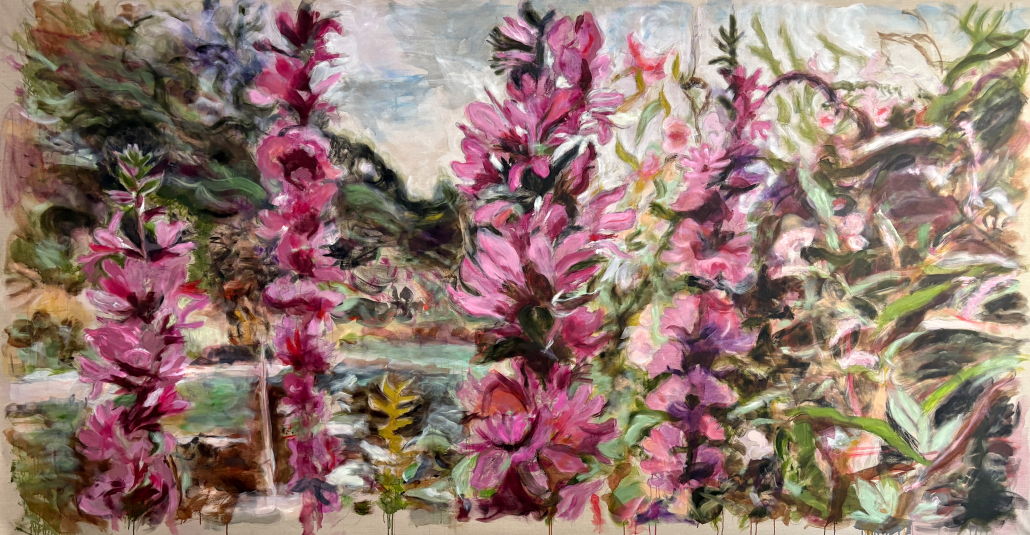
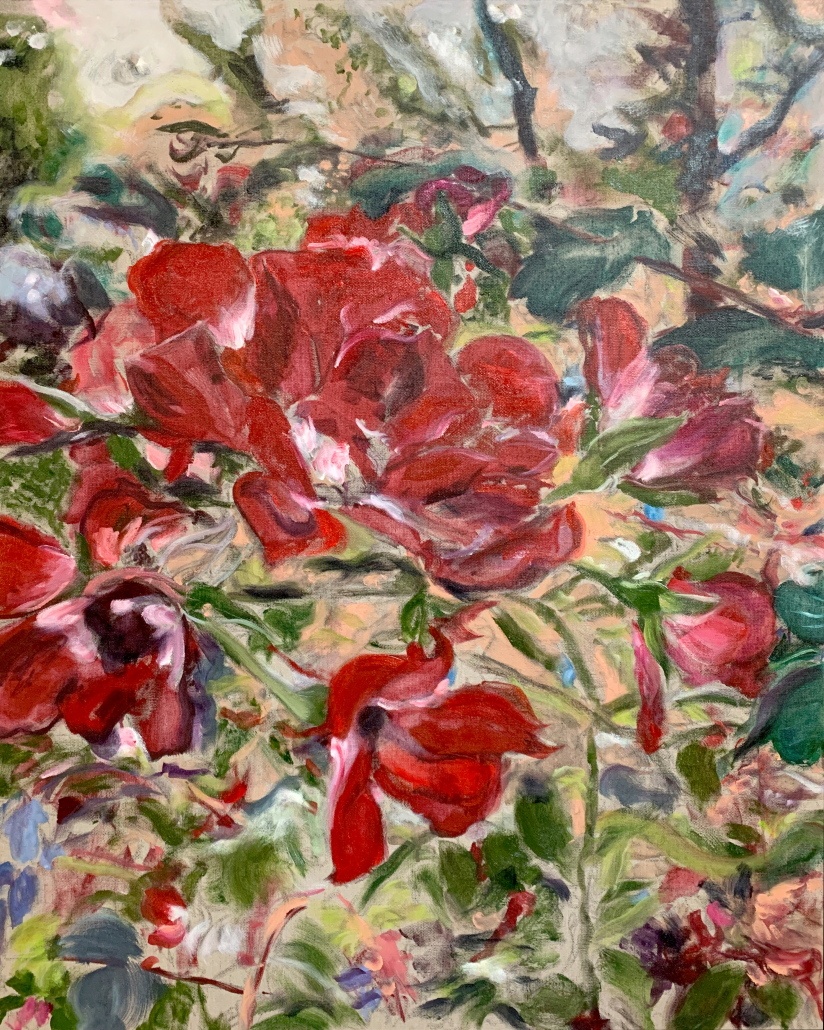
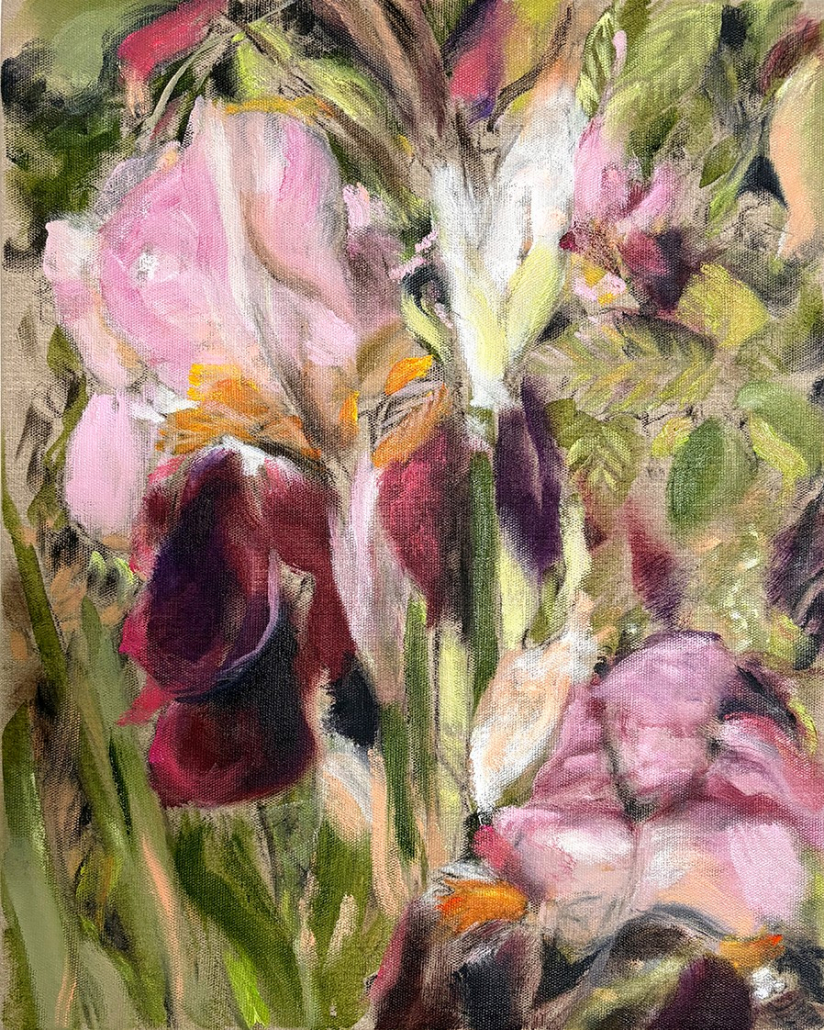
Tanja Selzer’s painting originates in the close observation of plants, landscapes and natural phenomena. Her paintings, however, are not botanical descriptions. In the process of painting, the motifs gradually detach themselves from their concrete appearance. Contours lose their definition, forms overlap, and colour and light develop a dynamic of their own. The result is a series of complex pictorial spaces that move between figuration and dissolution.
In Selzer’s work, plants do not appear as isolated objects, but as part of living structures. Blossoms, leaves and branches emerge only to recede from view again. Close-up and distance, precision and blurring, observation and memory intertwine. Rather than opening up spaces that can be read unequivocally, her paintings create atmospheric states in which the visible is constantly shifting.
The particular tension of the exhibition arises from the different artistic means employed by the two artists. Painting and sculpture do not illustrate one another, but offer different perspectives on related processes. While Tanja Selzer’s paintings create organic pictorial spaces through colour, light and painterly depth, Wolfgang Flad’s sculptures enter physical space directly through material, volume and void. In the dialogue between these different forms of expression, connections become visible that extend beyond formal similarities.
This juxtaposition does not produce a unified image of nature. Instead, nature emerges as a dynamic structure shaped by change, interdependence and continual transformation. Forms grow, branch out, overlap, dissolve and emerge anew. In both artistic positions, form therefore appears not as a final state, but as a moment within an open-ended process.
This also reveals another meaning of the exhibition’s title. LIAISONS refers not only to visible connections, but also to relationships that only emerge through the act of looking. A transition of colour may echo a sculptural form; an opening within a sculpture may alter the way a painting is perceived; a previously overlooked structure may suddenly become apparent through the presence of a neighbouring work. The exhibition does not prescribe these relationships. Instead, it allows viewers the freedom to discover correspondences of their own.
This openness is central to the exhibition. The works do not prescribe a single interpretation or lead to a definitive statement about nature. Rather, they invite us to experience perception as an active process. What we see depends not only on the individual work, but also on our own movement, the time we spend looking, our memories and personal associations.
Nature is presented neither as a romantic counter-image to civilisation nor as the illustration of an ecological thesis. Instead, it appears as a network of relationships of which humankind is itself a part. The exhibition thus also raises the question of how we position ourselves in relation to our environment: as observers looking at something supposedly separate from ourselves, or as part of a complex system that we affect and on which we simultaneously depend.
LIAISONS unfolds in the spaces in between: between the works, between perception and memory, between material presence and imagination. The exhibition creates a situation in which connections become visible while differences remain tangible. The connections that emerge are ultimately determined through the encounter with the works and through each viewer’s individual way of seeing.
Wolfgang Flad
Sculpture
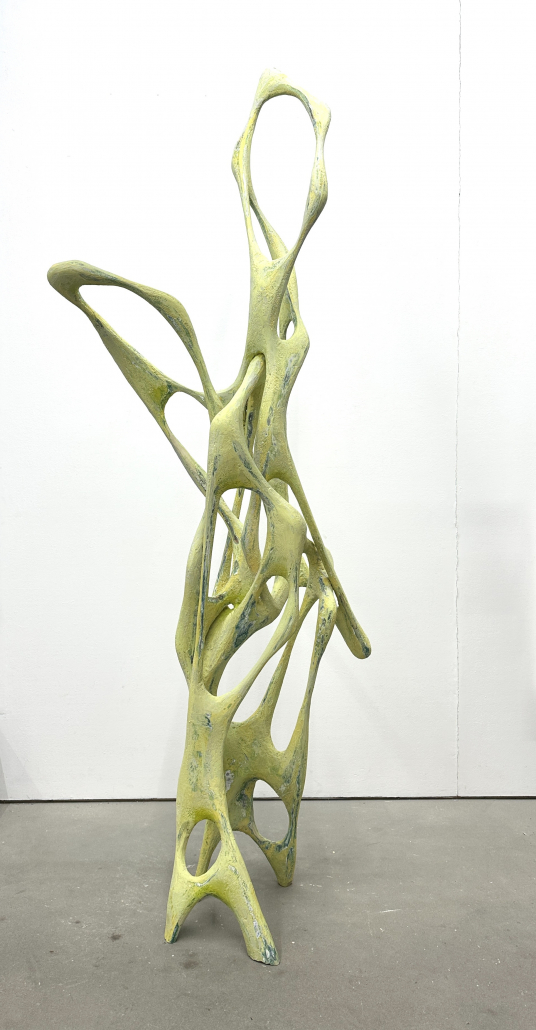
Untitled Structure, 2025
mixed media, 290 x 100 x 60 cm
Wolfgang Flad’s work operates at the intersection of sculpture, relief and painting. For more than two decades, he has explored the possibilities of sculpture anew, deliberately crossing the boundaries of these traditional genres. His works begin not with the representation of an object, but with an exploration of material, space and transformation.
For Flad, material is never an end in itself. Wood, papier-mâché, expanding foam, aluminium, bronze or studio dust interest him not simply for their physical properties, but for their potential for transformation. Through the artistic process, they lose their original function and acquire a new spatial and aesthetic autonomy. Simple materials are transformed into complex forms, shifting attention from the material itself to the process of its transformation.
His sculptures evoke cellular structures, corals, roots, bones or organic processes of growth without depicting specific natural forms. They appear like drawings in space, unfolding freely and changing their effect through the interplay of light, shadow and movement.
Over the course of his practice, Flad’s focus has increasingly shifted from the individual material to the process of its transformation. While his early wood carvings and multi-layered lacquer reliefs primarily explored the treatment and structure of surfaces, more recent bodies of work incorporate processes of creation, abrasion and change into the work itself. Series such as Dark Side of the Moon expand this approach to include geological and cosmic associations. In his most recent works, Flad takes this idea a step further: for his Dust Paintings, he uses the sanding dust generated in the production of his sculptures as the raw material for new works. Creation and dissolution, loss and renewal thus become part of the same creative cycle.
What unites these different bodies of work is an interest in transitions – between surface and space, construction and growth, destruction and renewal. Flad’s works reveal form not as a fixed state, but as a continual process of becoming. It is precisely this openness that gives his sculptures and reliefs their distinctive quality: they create spaces of experience in which material, light and movement become equally important elements of perception.
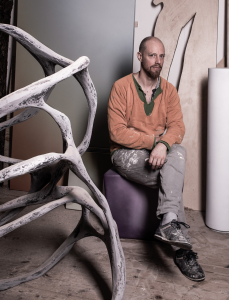
Wolfgang Flad was born in Reutlingen in 1974. From 1995 to 2000, he studied Textile Design at Reutlingen University of Applied Sciences before studying Fine Art at the State Academy of Fine Arts Stuttgart. He has lived and worked as an independent artist in Berlin since 2004.
Further information about the artist can be found here.
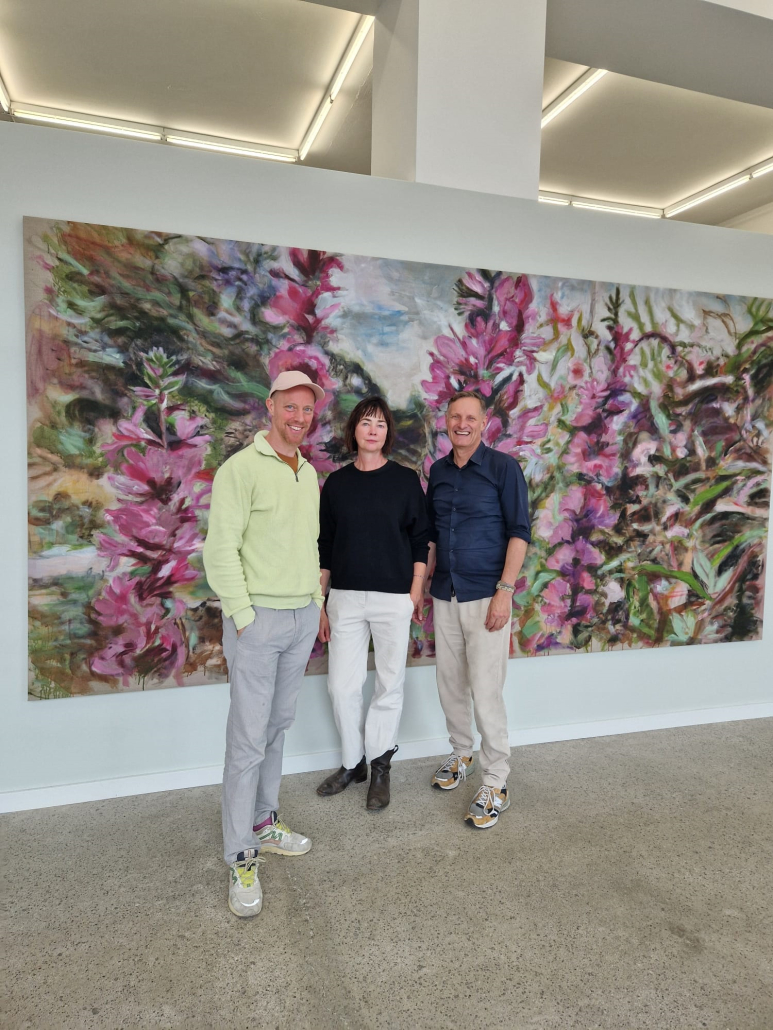
Photo Wolfgang Flad: ©Dale Grant
Tanja Selzer
Painting
Let the dragons out, 2026
Oil on canvas, 195 x 385 cm
For more than twenty years, Tanja Selzer has developed a body of paintings that continually moves between figuration and dissolution, exploring the possibilities of perception. Her works often originate in photographs, memories or direct observations of nature. In the process of painting, however, these sources increasingly detach themselves from their concrete appearance and develop a pictorial reality of their own.
In her earlier bodies of work, Selzer explored corporeality, intimacy and the ways in which images create proximity and distance. Figures appear not as narrative protagonists, but as projection surfaces for questions of intimacy, desire and identity. Her paintings resist unequivocal interpretations while simultaneously questioning the role of the viewer.
In recent years, this artistic interest has increasingly shifted towards nature. Human figures have given way to landscapes, animals and, in particular, plants. Her gaze is now directed less towards interpersonal relationships than towards processes of becoming, growth and decay. It is not the underlying artistic question that has changed, but the field of motifs through which Selzer explores it.
Nature therefore appears in her work not as a botanical motif, but as a living network of relationships. Forms grow, overlap, dissolve and emerge anew. Figuration remains recognisable without determining the viewer’s gaze. Instead, Selzer creates pictorial spaces in which colour, light and movement themselves become carriers of atmosphere and meaning.
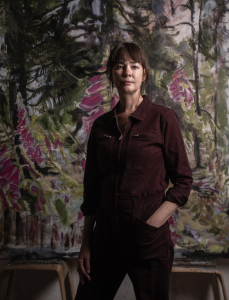
Tanja Selzer (born 1970 in Rhineland-Palatinate) graduated from Hamburg University of Applied Sciences in the field of Design, with a focus on painting. Since 2005, her works have been exhibited in Germany and internationally and are represented in public and private collections. She is a member of the MalerinnenNetzWerk Berlin-Leipzig and Saloon Berlin and lives and works in Berlin.
Further information about the artist can be found here.
Photo Tanja Selzer: ©Dale Grant
Wolfgang Flad | Tanja Selzer LIAISONS Sculpture | Painting
11 September – 24 October 2026
Vernissage: Thursday, 10 September 2026, 6 p.m.
Venue: nüüd.berlin gallery, Kronenstr. 18, 10117 Berlin-Mitte, U Stadtmitte
Open: Wed – Sat, 12 – 6 p.m. & by appointment
